


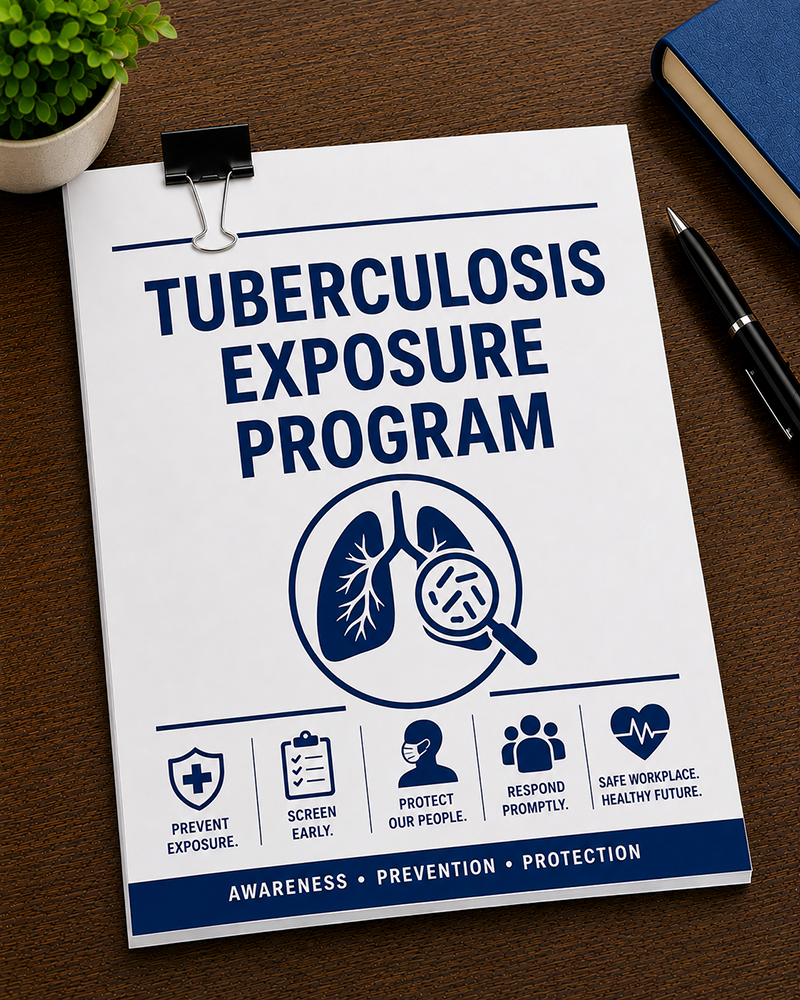
Tuberculosis Exposure Control Safety Program
$25.00
The Tuberculosis Exposure Control Safety Program establishes requirements for protecting employees who may experience occupational exposure to tuberculosis (TB), including Mycobacterium tuberculosis. TB is primarily transmitted through airborne particles released when a person with infectious pulmonary or laryngeal tuberculosis coughs, speaks, or otherwise generates infectious aerosols. The program emphasizes TB exposure prevention, hazard recognition, infection-control practices, employee training, and prompt response to suspected or confirmed occupational exposures.
The program addresses tuberculosis exposure control, TB risk assessment, airborne infection precautions, respiratory protection, N95 respirators, respirator fit testing, medical evaluation, exposure incidents, employee screening, and infection-control procedures. Employees who may enter areas where infectious TB is suspected or confirmed must follow established precautions and use required respiratory protection and other personal protective equipment (PPE). Appropriate work practices and administrative or engineering controls must be used to minimize employee exposure. The program also addresses procedures following potential occupational TB exposure, confidential medical evaluation and follow-up, employee responsibilities, training, documentation, and coordination with healthcare or public-health professionals when necessary. Effective Tuberculosis Exposure Control helps reduce workplace transmission and protects employees who may encounter infectious TB during their work.
Description
The Tuberculosis Exposure Control Safety Program provides a structured approach for protecting employees who may have occupational exposure to infectious tuberculosis. It establishes responsibilities for management, supervisors, and affected employees and addresses exposure-risk assessment, infection-control measures, respiratory protection, employee screening, and appropriate response following suspected or confirmed occupational exposure.
The program addresses airborne infection precautions, exposure assessments, administrative and engineering controls, respiratory protection, N95 respirators and other appropriate respirators, medical evaluations, respirator fit testing, employee screening, exposure incidents, confidential medical follow-up, employee training, documentation, and coordination with healthcare and public-health professionals. It also establishes procedures for identifying work situations requiring additional precautions, limiting employee exposure, and responding when an employee may have been exposed to a person with suspected or confirmed infectious TB.
Provided in editable Microsoft Word format, the program can be customized for your company’s facilities, employee exposure risks, infection-control procedures, respiratory protection practices, medical arrangements, and employee responsibilities. It can be incorporated into a comprehensive Safety Manual or used as a standalone Tuberculosis Exposure Control Safety Program.


