


 Abrasive Blasting Safety Program
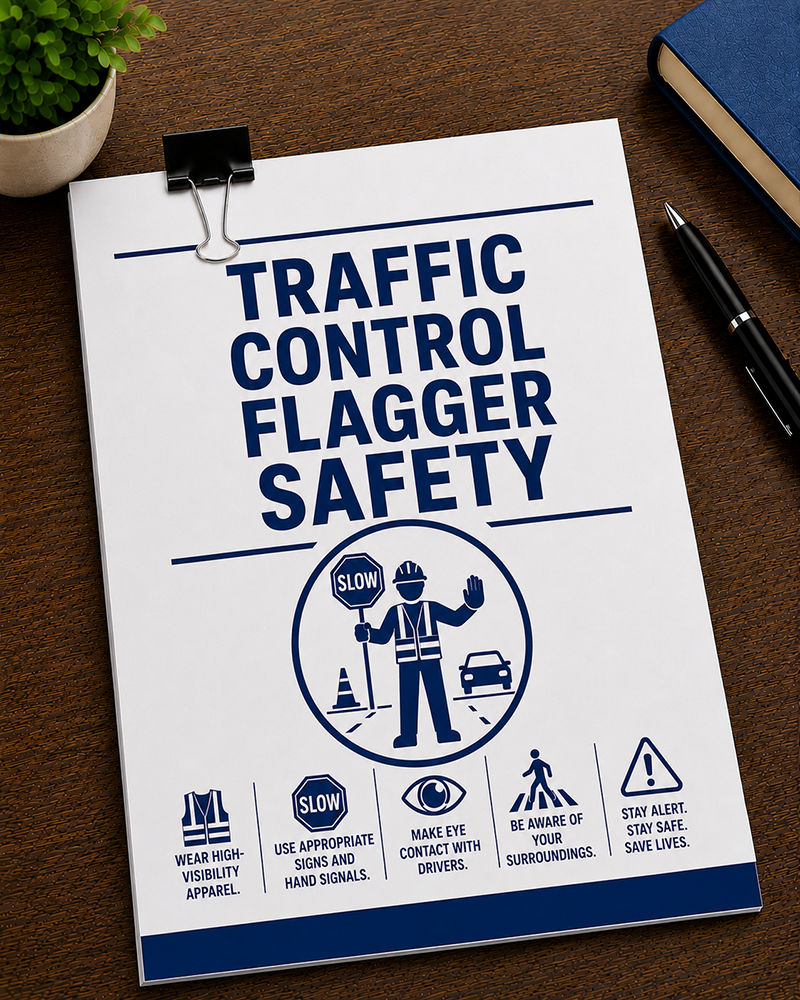
Traffic Control Flagger Safety Program
$25.00
The Traffic Control Flagger Safety Program establishes requirements for protecting employees who perform flagging and temporary traffic control where construction, maintenance, utility, roadway, or other work activities expose employees to moving vehicles and mobile equipment. Flaggers play a critical role in protecting workers, motorists, pedestrians, and the public by controlling traffic through or around work zones. The program emphasizes proper flagger positioning, visibility, communication, traffic-control devices, and established procedures to reduce struck-by hazards and prevent traffic-related incidents.
The program addresses flagger safety, traffic control, work zone safety, temporary traffic control, high-visibility apparel, STOP/SLOW paddles, hand signals, advance warning signs, cones, barricades, channelizing devices, escape routes, and communication procedures. Flaggers must remain alert, face approaching traffic, stand in a safe and visible location, maintain an identified escape route, and avoid distractions that could interfere with traffic-control duties. Flaggers must never stand directly in the path of approaching vehicles and must coordinate with other flaggers when traffic is controlled from multiple locations. The program also addresses night work, adverse weather, pedestrian safety, emergency vehicles, traffic-control setup and removal, employee responsibilities, inspections, and flagger training to help prevent struck-by incidents and improve roadway work zone safety.
Description
The Traffic Control Flagger Safety Program provides detailed requirements for employees assigned to control vehicle or pedestrian movement through temporary traffic-control areas and work zones. It establishes responsibilities for management, supervisors, flaggers, and other affected employees and addresses work-zone planning, flagger positioning, visibility, communication, traffic-control devices, and protection from moving vehicles and mobile equipment.
The program addresses STOP/SLOW paddles and hand signals, high-visibility apparel, advance warning signs, cones and channelizing devices, barricades, flagger stations, escape routes, multi-flagger operations, pedestrian control, night work, adverse weather, emergency vehicles, communication methods, and traffic-control setup and removal. It also establishes practices for maintaining continuous awareness of approaching traffic, coordinating traffic movements, preventing conflicting instructions, and adjusting operations when changing roadway or work-zone conditions create additional hazards.
Provided in editable Microsoft Word format, the program can be customized for your company’s roadway activities, work zones, traffic-control procedures, flagger responsibilities, equipment, and communication methods. It can be incorporated into a comprehensive Safety Manual or used as a standalone Traffic Control Flagger Safety Program.


