


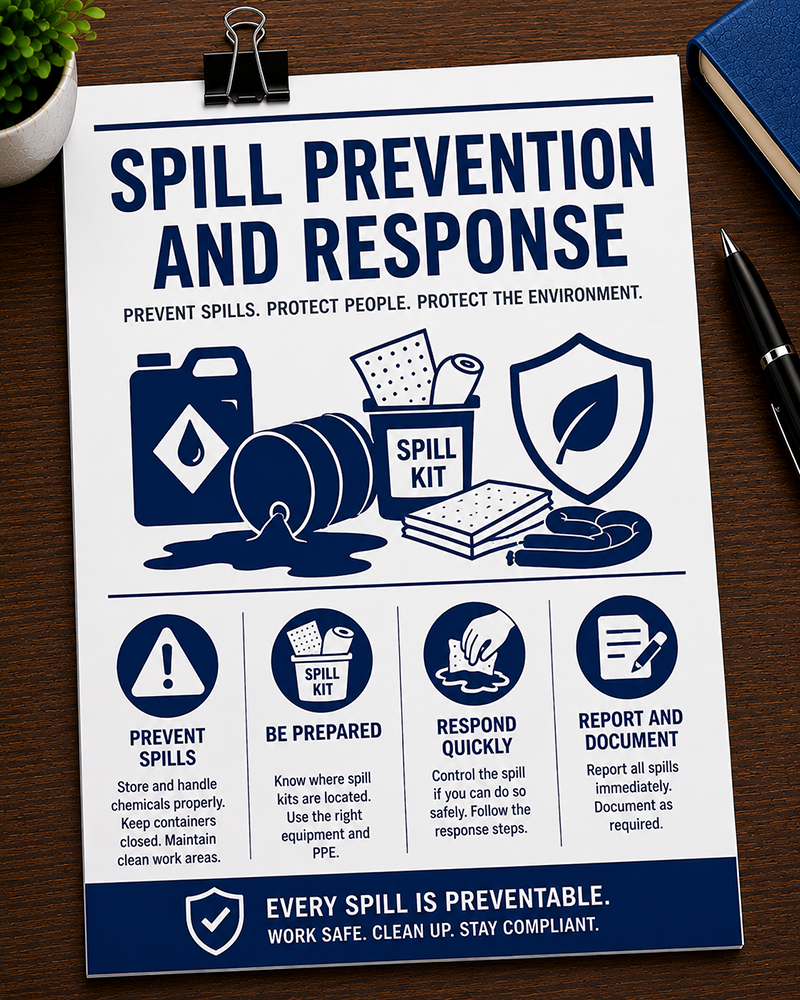
Spill Prevention and Response Program
$25.00
The Spill Prevention and Response Program establishes requirements for preventing, controlling, reporting, and responding to hazardous material, chemical, fuel, oil, and other workplace spills. Effective spill prevention begins with proper storage, handling, labeling, secondary containment, equipment inspection, and employee awareness. The program emphasizes preventing releases whenever possible and ensuring employees understand how to safely respond when a spill occurs while protecting themselves, coworkers, property, and the environment.
The program addresses spill prevention, spill response, hazardous materials, chemical spills, fuel and oil spills, secondary containment, spill kits, personal protective equipment (PPE), emergency response, cleanup, reporting, and waste disposal. Employees must promptly report spills and releases, protect drains and waterways when it can be done safely, and use appropriate spill-control materials and PPE within the limits of their training. Employees must not attempt to clean up spills that are unknown, highly hazardous, beyond their training or available equipment, or that require an emergency response. Spill areas must be secured when necessary, ignition sources controlled, and appropriate emergency or environmental personnel contacted. The program also addresses container management, inspections, spill-response equipment, cleanup materials, contaminated waste, incident documentation, employee training, and corrective actions to help prevent chemical releases, environmental contamination, fires, exposures, and workplace injuries.
Description
The Spill Prevention and Response Program provides a structured approach for preventing accidental releases and managing spills involving chemicals, fuels, oils, hazardous materials, and other substances used or stored in the workplace. It establishes responsibilities for management, supervisors, and employees and addresses prevention measures, spill assessment, initial response, notification, containment, cleanup, and post-incident corrective action.
The program addresses container storage and handling, secondary containment, inspections, spill kits and response equipment, PPE, ignition-source control, drain and waterway protection, spill containment, cleanup materials, contaminated waste, emergency notification, reporting, and incident documentation. It also establishes criteria for distinguishing incidental spills that trained employees may safely manage from releases that require evacuation, specialized responders, or emergency assistance and emphasizes that employees must never exceed their training or available protective equipment.
Provided in editable Microsoft Word format, the program can be customized for your company’s chemicals and materials, storage areas, spill-response equipment, notification procedures, emergency contacts, and employee responsibilities. It can be incorporated into a comprehensive Safety Manual or used as a standalone Spill Prevention and Response Program.


